
Ingham County Parole or Probation
Parole is conditional release from a Michigan Department of Corrections prison sentence. The Michigan Parole Board is the sole state paroling authority, while the Field Operations Administration manages community supervision. A person on parole has left prison but remains under MDOC authority. Probation is a court-ordered community sentence. It can begin without any prison term, and felony probation is commonly supervised by MDOC for the sentencing court.
A bond release from the Ingham County Correctional Facility is different. That person may face court dates or pretrial conditions while having no MDOC parole or probation record. A completed county jail sentence may also end without state supervision. The official custody route matters more than the broad word “released.”
| Feature | Parole | Probation |
|---|---|---|
| Starting point | Release from an MDOC prison sentence | Sentence imposed by a court in the community |
| Authority | Michigan Parole Board and MDOC | Sentencing court, with MDOC supervision in covered felony cases |
| OTIS status | PAROLE | PROB |
| Ending event | Discharge from MDOC jurisdiction or maximum date | Court or MDOC discharge at the end of the order |
The status `DISCHRG` means MDOC jurisdiction ended for the displayed sentence. It does not always describe a recent community release. OTIS notes that discharge can follow successful supervision, the maximum term, or death before completion, so the dates and sentence fields must be read with the status.
- Parole
- Conditional community release from an MDOC prison sentence.
- Probation
- A court sentence served in the community under stated conditions.
- Discharge
- The end of MDOC authority on the displayed sentence or supervision term.
- Absconder
- A supervised person recorded as having stopped reporting and being sought by the responsible authority.
Verify Ingham County Post-Release Supervision
The Offender Tracking Information System, or OTIS, is the person-level starting point for MDOC parole and probation. It covers prisoners, parolees, probationers, and qualifying recently discharged records. It does not cover every person who spent time only in the Ingham County jail. Use an MDOC number when known because it is the strongest search key.
- Search OTIS by MDOC number or last name. Add first name, age, sex, or race only when needed to separate close matches.
- Choose `Parolees`, `Probationers`, or `All` based on the known custody path. Do not use a photograph alone to identify the record.
- Read Current Status, supervision location, sentence entries, Date Paroled, and discharge or maximum dates together.
- Use the office named on the record. Ingham County has separate parole and probation offices, so the status controls the correct contact.
- For a time-sensitive question, ask MDOC or the assigned office to confirm the current status. OTIS warns that some displayed facts can lag.
A current `PAROLE` entry is strong evidence that the person left prison and remains under supervision. `PROB` identifies probation, not parole. A county-jail name that is absent from OTIS may simply reflect that MDOC never had jurisdiction. For the original county release event, the Ingham County released-inmate lookup paths point instead to the Sheriff, VINE, and court record.
Note: An OTIS miss does not prove that supervision ended because public display and MDOC record-retention periods are different.
Ingham County Supervision Offices Differ
MDOC Region 7 lists two local offices. The Ingham County Parole Office is at 5341 South Pennsylvania Avenue in Lansing and can be reached at 517-284-7667. The Ingham County Probation Office is at 303 West Kalamazoo Street, Suite 90, Lansing, and its number is 517-483-6100. An office can confirm routing but may limit details about an individual.
Local MDOC Supervision
Parole Office
5341 South Pennsylvania Avenue
Lansing, MI 48913
517-284-7667
Probation Office
303 West Kalamazoo Street, Suite 90
Lansing, MI 48933
517-483-6100
The central Field Operations Administration provides another official route when the local assignment is unclear. FOA is at Grandview Plaza, 206 East Michigan Avenue, Lansing, with public hours listed as Monday through Friday, 8:00 a.m. to 5:00 p.m.; 517-335-1979; `mdoc-foa-admin-public@michigan.gov`. Michigan Parole Board staff can be reached at 517-373-0270 or `Parole-Board-Staff@michigan.gov` for Board process questions.
The official MDOC office directory shows how Michigan routes parole and probation contacts.
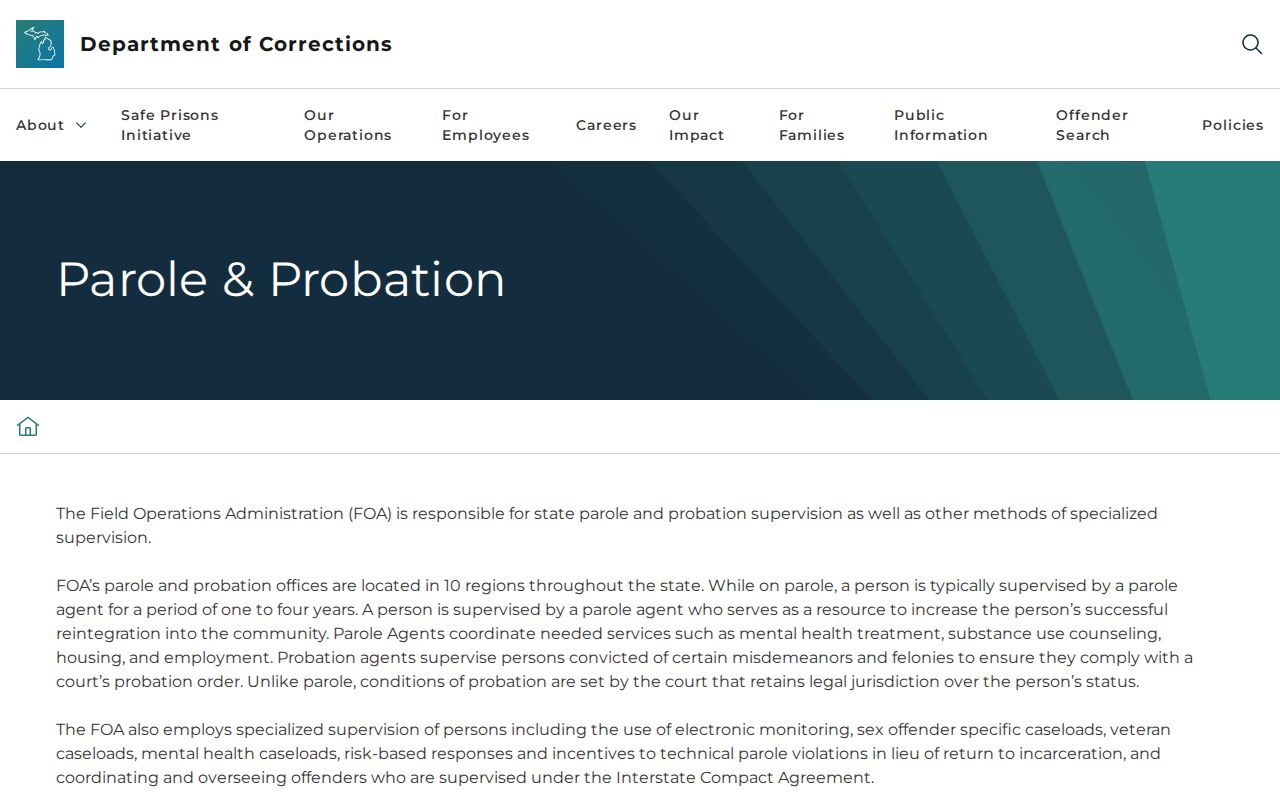
The directory should be paired with the OTIS supervision location because an Ingham County connection does not guarantee a current Ingham office assignment.
Ingham County Parole Grant Status
A favorable Michigan Parole Board decision is not the same as a completed release. The Parole Release Unit documents the decision, projected parole date, supervision term, and special conditions, then coordinates placement. New adverse information or misconduct can suspend a grant before the person leaves prison. The stronger public signs of actual parole release are a `PAROLE` status and a Date Paroled in OTIS.
Michigan does not publish a complete calendar of all routine parole interviews or a searchable named-person decisions database. Selected public lifer, commutation, and pardon hearings appear on the public hearing registration page. Quarterly Parole Board Decisions Reports contain grant, deny, and defer totals, not names. A denial can lead to later review, while a deferral can allow more information or placement work. None proves an exit from custody.
Actual release check: Treat a grant or projected date as pending until OTIS shows Date Paroled and a current parole status, then confirm with MDOC when timing matters.
Eligibility follows MCL 791.233 and 791.234. For covered Michigan truth-in-sentencing cases, the person serves the full judicial minimum before parole consideration. Michigan is not an 85-percent minimum state.
Ingham County Absconder Status
OTIS provides separate Parole Absconders and Probation Absconders filters. `ABSCOND1` identifies a parole absconder actively sought by MDOC. `ABSCOND2` identifies a probation absconder whose sentencing county retains jurisdiction. The label reports supervision status. It does not establish a new conviction.
Do not attempt contact or apprehension based on a public result. MDOC lists an Absconder/Escapee Tip Line at 517-755-0855, while an immediate safety issue belongs with 911 or local law enforcement. Michigan VINE can send custody-event alerts, but it is not a supervision-office directory and does not replace an OTIS status check.
Conditions vary with the sentence and official order. Common categories may concern reporting, location, treatment, contact, travel, or other conduct, but only the controlling order and supervising officer state the terms for one person. A violation allegation can lead to a review, warrant, or custody action. It should not be treated as a final finding without the official record.
Note: Aggregate absconder reports describe statewide counts; OTIS and the assigned office are the person-specific sources.
Ingham County Release Support
Ingham County has a local bridge from jail custody to ongoing care. The Sheriff’s Correctional Assessment and Treatment Services re-entry team connects people with continuing medical and behavioral services. The Sheriff resource guide also states that Narcan kits are available at the jail exit or lobby. These services can aid a return to the community, but they are not proof of parole, probation, or discharge.
Ingham County Community Corrections and Pretrial Services serve other roles. Pretrial Services supervises certain people conditionally released on bond while a case is pending. That is not parole. Community Corrections coordinates eligible program referrals, but participation alone does not establish a state supervision status. OTIS and the court order remain the key records.
This distinction prevents a common error. A person can receive re-entry help after a county jail release with no MDOC supervision, while a parolee can be assigned to an office outside Ingham County. Verify the legal status first, then use the service contact that fits.
Note: Re-entry services help with the return to the community but do not establish parole, probation, or discharge status.
Ingham County Release Records Change
Property release and public-record access follow separate tracks. The Ingham jail visitor packet permits an inmate to complete a property-release form naming a person who may retrieve property with identification in the correctional-facility lobby. That form concerns property. It does not show that the inmate was discharged or that supervision ended.
Michigan’s automatic Clean Slate system can make qualifying arrest, conviction, and sentence records nonpublic after state and court processing. That helps explain why an older public reference may later differ from a current OTIS or court search. It does not authorize guessing about the person’s status. The Michigan set-aside rules are case-specific, and the originating court or agency must explain what remains available.
For an MDOC record no longer shown publicly, MDOC directs questions about past prisoner records up to six years after release to `MDOC-Records_Retention@michigan.gov` or 517-780-5471. OTIS generally displays eligible records for three years after the most recent supervision discharge. Those are different channels and different windows.
When Ingham County Supervision Ends
Supervision ends through an official discharge, expiration, or court action, not merely because public contact with an office stops. For parole, MDOC remains the authority until discharge or the controlling maximum. For probation, the sentencing court retains judicial power while MDOC performs covered supervision. Read the order, OTIS status, and discharge date together.
If the person is `DISCHRG`, note the sentence attached to that status and any other active case. One discharge does not prove every court matter ended. A court docket may show later orders, and another jurisdiction may have separate authority. For written confirmation, MDOC records and the correct court clerk provide stronger evidence than an old screenshot.
Is absence from the jail roster proof of parole? No. The person may have bonded out, completed a local sentence, transferred, or never entered the jail. Parole is tied to an MDOC prison sentence and a Board-authorized release.