
Ingham County Projected Release Dates
A projected date is a calculation or expected milestone. It is not a promise that the person will leave custody on that day. Michigan’s public prison records use several precise date labels, including the Parole Board Jurisdiction Date, Maximum Date, and Date Paroled. Each answers a different question. County jail records use the local sentence, jail credit, and any applicable county-jail good time.
A pretrial detainee has no set sentence expiration. Bond payment, a recognizance order, dismissal, a plea, a new hold, or another court order may control the next event. Even when a judge signs an order, release staff must check other cases and warrants before physical departure. Ingham’s release coordinator workflow makes that difference especially clear.
Scheduled versus actual: A projected date, parole eligibility date, or signed order is not the final exit record. Confirm physical release with the custodian.
A transfer also ends one agency’s custody without putting the person into the community. Someone moved from Ingham County to MDOC should be checked in OTIS. Another county, a federal agency, or immigration custody requires that receiving agency’s system.
- Projected date
- A calculated or planned date that can still change.
- PBJ date
- The date the Parole Board first obtains jurisdiction to consider parole under the sentence rules.
- Date Paroled
- The date a person actually left an MDOC prison on parole.
- Maximum Date
- The potential end of MDOC authority under the controlling sentence and credit rules.
Ingham County OTIS Date Fields
The Michigan Offender Tracking Information System, known as OTIS, is the correct public route for a person under MDOC jurisdiction or within its qualifying post-discharge display period. It does not cover someone whose only custodial sentence was in the Ingham County jail or a city lockup. A local booking and an MDOC sentence are separate records.
| OTIS field | What it means | What it does not prove |
|---|---|---|
| Parole Board Jurisdiction Date | Earliest point at which the Board may consider parole under the computed minimum | That parole was granted or release occurred |
| Maximum Date | Potential end of MDOC authority under the sentence rules | A planned community release before that date |
| Date Paroled | Actual departure from prison on parole | That supervision has ended |
| Current Status | Prisoner, parole, probation, discharge, absconder, or another MDOC status | Status in a county, federal, or immigration system |
| Probation discharge or maximum | Expected end of the probation order, subject to court action | A prison release date |
Michigan has indeterminate sentencing for many cases. A court sets a minimum and maximum. The Board obtains jurisdiction at the legally computed minimum or PBJ date, may grant parole after that point, or may decline parole until later. A PBJ date can pass while the person remains in prison. That is not, by itself, a data error.
Note: Always preserve the date label because copying a bare date can turn parole eligibility into a false claim of release.
Find an Ingham County Release Date
Begin with the last custodian. The same person may have a police incident number, an Ingham booking number, a court case number, and an MDOC number. These identifiers track different events. Using the wrong system is the most common reason a date search fails. The county locator checks current adult jail custody, while the Ingham court search helps locate the linked judicial action.
- Determine whether the person is awaiting trial, serving an Ingham County jail sentence, or serving an MDOC prison sentence. Check the court case when the custody path is uncertain.
- For an MDOC case, search OTIS by MDOC number or name. Match the record by identifiers, then read the PBJ, maximum, Date Paroled, status, and sentence entries together.
- For an Ingham County sentence, call the jail information line at 517-676-2431, option 3, and ask for the local sentence computation and actual release or transfer status.
- For a pretrial case, read the correct 30th Circuit, 54-A, 54-B, or 55th District Court record for bond and later orders. Ask the jail whether processing is complete.
- If a transfer occurred, use the receiving agency. OTIS is for MDOC, the BOP locator is for federal prisoners, and another county uses its own records.
- For documentary proof, request the Sheriff’s booking/release sheet or MDOC sentence and discharge material, with the person’s full name and identifiers.
The Ingham County released-inmate search covers the broader path when the last custodian is unclear. A present hit in the live jail locator indicates recorded current custody, not a future date. An absent name does not establish release because transfer, spelling, delay, or a different agency can explain the miss.
Read Ingham County OTIS Results
The official OTIS search screen accepts an MDOC number or a name and provides filters for status and identifying traits.
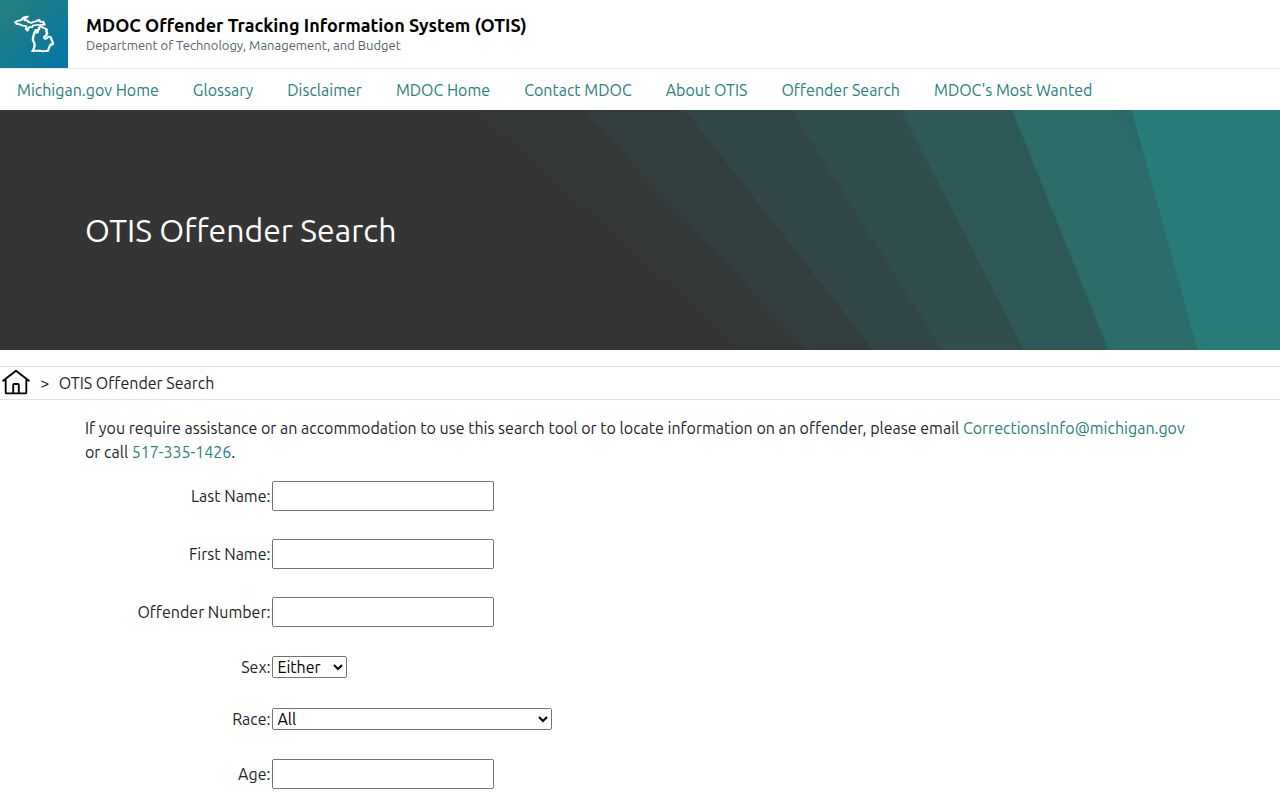
The form is useful only when MDOC had jurisdiction. After opening a match, look for the current status and labeled sentence dates rather than relying on the search-result name or photograph.
OTIS warns that status, location, and projected dates may not be current. The MDOC number is its most accurate search route. A last-name search can use a trailing wildcard after three leading letters, while extra exact-match filters can hide a valid record. Search broadly first, then narrow carefully.
OTIS generally keeps eligible discharged records public for three years after the most recent supervision discharge. MDOC separately accepts inquiries about past prisoner records up to six years after release through `MDOC-Records_Retention@michigan.gov` or 517-780-5471. A record that is no longer online can still have an official records route.
Ingham County Truth-in-Sentencing Rules
Michigan is a 100-percent-minimum truth-in-sentencing state for covered offenses. It is not an 85-percent state. MDOC states that covered prisoners serve the entire judicial minimum in prison before parole consideration. The law removes good time and disciplinary credits against that minimum and uses disciplinary time in Board review.
The modern rules apply to specified assaultive offenses committed on or after December 15, 1998, and other covered crimes committed on or after December 15, 2000. MCL 791.233 bars parole before the legally computed minimum, subject to the statute, and MCL 791.234 sets Board jurisdiction and special categories. A generic 15-percent reduction must not be applied to a covered Michigan minimum.
Reaching PBJ starts parole consideration. It does not require a grant. The Board can grant, deny, or defer based on the statutory process and public-safety judgment. A grant can also be suspended before release if new adverse information or misconduct arises. Date Paroled is the public field tied to an actual parole exit.
Does the minimum equal the actual release date? No. For a covered sentence it sets the earliest parole jurisdiction point, while the Board’s decision and release processing determine whether and when parole occurs.
Ingham County Legacy Credit Cases
Older Michigan sentences can follow legacy credit rules. MCL 800.33 and MDOC Policy Directive 03.01.100 largely limit general good-time eligibility to offenses before April 1, 1987, with listed exceptions. Credits rise by sentence year under the statute, and special good time is discretionary rather than a right.
Regular monthly credits range from five days in the first sentence years to fifteen days from year twenty under the legacy schedule. Class I misconduct may block, forfeit, or alter credits and affect the PBJ, minimum, or maximum calculation. Disciplinary time under MCL 800.34 is reported for Parole Board review; it should not be described as a modern earned-time discount.
The judgment supplies the minimum, maximum, and jail credit. MDOC then calculates the controlling dates under the offense date, sentence structure, and any applicable legacy rules. Consecutive terms, sentence corrections, new court orders, holds, credit changes, and data corrections may alter what OTIS displays. The MDOC time calculation is the reliable source for one person.
Note: Legacy credits are sentence-specific and must not be projected from the schedule without the official offense dates and MDOC calculation.
Ingham County Jail Date Calculation
A county jail sentence follows a different framework from an MDOC prison sentence. Ask the Ingham County Correctional Facility or the sentencing court for the judgment, jail credit, and official sentence computation. The Sheriff’s Corrections page supplies the jail information route. MCL 51.282 provides county-jail good-time allowances for qualifying sentences, while MCL 51.283 addresses forfeiture. Eligibility and the actual arithmetic belong to the jail record.
MCL 801.251 supplies a specific discharge-timing rule when a county-jail sentence expires on a Sunday or legal holiday, subject to the statute’s terms. That rule is a useful channel-sweep check because no Section 19 angle was assigned to the projected-date page. It does not create a public release feed or apply to every kind of custody.
Ingham’s Corrections Deputy-Release Coordinator prepares next-day packets for a scheduled 6:00 a.m. release cohort and checks court matters, pending warrants, restrictions, and dates. This local workflow does not mean all releases happen at that hour. Bond and court-order releases can follow different timing, and another hold can stop a planned departure.
A pretrial detainee remains outside this sentence calculation. Ask the correct court about bond or orders, then ask the jail whether physical processing is complete. A scheduled release and a completed release should stay distinct in any record note.
Why Ingham County Release Dates Change
A date can move because the legal inputs or custody facts changed. The source of the change also tells the reader where to verify it. Court changes belong with the clerk, MDOC computations with MDOC, and jail processing with the Ingham County Sheriff.
| Factor | Possible effect | Verification source |
|---|---|---|
| Parole decision | Grant, denial, or deferral changes whether release follows PBJ | OTIS and MDOC |
| Misconduct | May affect legacy credits, disciplinary time, or a pending grant | MDOC sentence record |
| Detainer or warrant | Can cause continued custody or transfer after one case authorizes release | Jail, court, and receiving agency |
| New or corrected order | Can alter minimum, maximum, jail credit, or sentence structure | Sentencing court and MDOC |
| Consecutive sentence | One term may run after another instead of at the same time | Judgment and official computation |
| Data correction | Displayed date may change without a new custody event | Originating records office |
A favorable order in one of Ingham’s four trial-court paths can coexist with another case or hold. The 30th Circuit Court and 54-A, 54-B, and 55th District Courts cover different matters and places. Search each relevant case number rather than assuming one order resolves the whole custody picture.
Note: A changed display can reflect a corrected calculation, not necessarily a new release or custody event.
Confirm Ingham County Actual Release
Use the agency that physically held the person. For the Ingham County jail, call 517-676-2431, option 3, and ask whether the person left, the date and time, the release type, and whether another agency received them. A Sheriff booking/release sheet or release transaction gives durable proof. For MDOC, combine OTIS with an MDOC records response when exact timing matters.
Michigan VINE can provide a custody-event notice, but it is not the certified release record. Register while the record is eligible, then confirm any alert with the jail or MDOC. The Ingham County VINE inmate check explains the agency-specific record and phone PIN process.
If the projected date has passed, do not infer release. Check current status, Date Paroled, another hold, and the court record. The person may still be held, may have transferred, or may have a corrected calculation. Exact wording matters: projected, eligible, granted, paroled, transferred, and discharged describe different stages.